
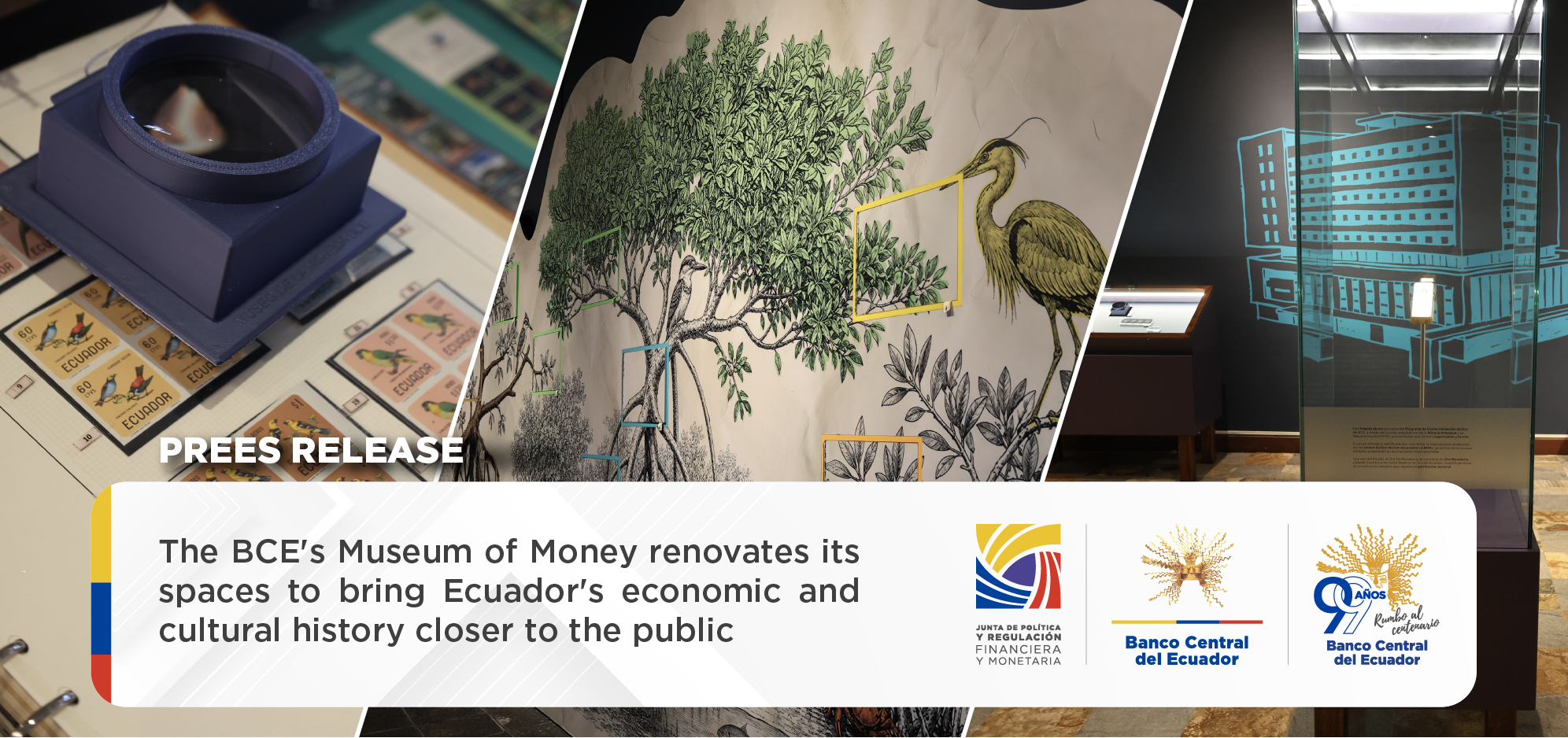
The new museographic proposal incorporates exhibition resources, historical pieces, and experiences that strengthen the conservation and appreciation of the country’s numismatic, philatelic, and historical heritage.
On August 25, the Central Bank of Ecuador (BCE) inaugurated two rooms at the Museum of Money, as part of the renewed museographic proposal titled “Paths to Explore Our History”. The modernization of this cultural space, located in Quito, included improvements to Room 5, “What Does the BCE Do?”, and to the Philately Room, “Travelers of Paper: A Journey Through Postal History.” As part of this project, areas, display cases, and fixtures were refurbished, and new exhibits were added to enhance the permanent collection.
One of the new features is “The Mangrove of Time,” a display that, in addition to inviting visitors to understand history as an ecosystem in which different eras meet and intertwine, seeks to create connections between the Museum’s content, visitors’ surroundings, and their everyday experiences. The renovation also includes a display of seven gold coins from the Spanish colonial period, in denominations of 1, 2, 4, and 8 reales, featuring a mirror system that allows visitors to view both the obverse and reverse of these pieces simultaneously, among other additions.
A new look at postal history
With more than 7,000 items, the Philately Room presents, for the first time on a permanent basis, a collection donated by the family of César Molestina Oquendo, a distinguished Ecuadorian philatelist and professor. The exhibit invites visitors to discover how Ecuador and the world have told their history through stamps, letters, postcards, and more. The exhibition is organized around five themes: the origins of the postal service and pre-philately; the stamp as an expression of national identity; Ecuador’s connection with the world; collecting and conservation practices; and the circulation of letters and stamps as a record of routes, times, and destinations.
The BCE and everyday life
Room 5, “What Does the BCE Do?”, offers a closer, more experiential look at the work of this public institution and its connection to the economy and daily life. The space displays a non-monetary gold bar and other notable pieces, such as commemorative coins from 14 countries in the “Ibero-American Series”; issues linked to the 2006, 2014, 2022, and 2026 FIFA World Cups; the BCE’s own exhibits from 1995 to 2025; medal dies and punches; and fractional dollar coins from 2000 and 2023.
With this renovation, the BCE, through the Museum of Money, reaffirms its commitment to the conservation, research, dissemination, and public access to the heritage it safeguards. It also creates new ways of bringing the country’s economic, monetary, philatelic, and cultural history closer to the public.
Strategic Communications Sub-Directorate


