
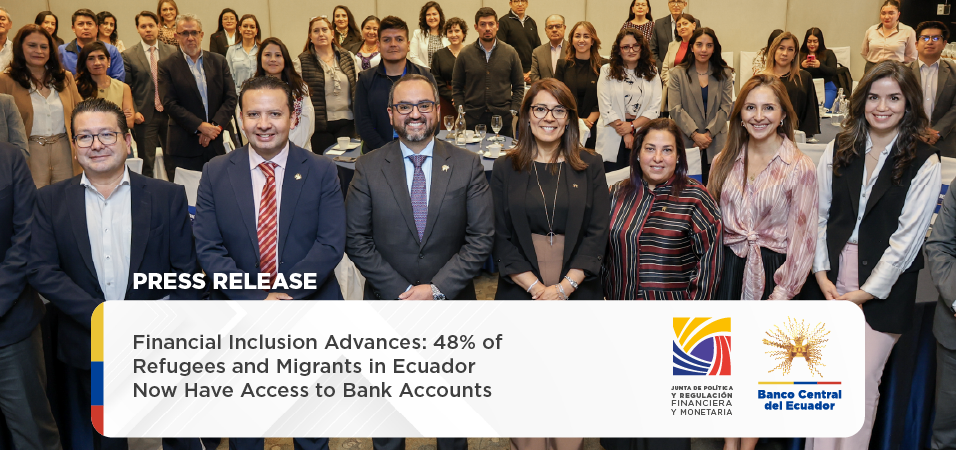
Access to bank accounts for refugees and migrants in Ecuador increased from 11% in 2022 to 48% in 2025, according to UNHCR Ecuador’s Annual Monitoring Survey. This progress reflects the country’s efforts to reduce barriers to accessing the financial system and strengthen the economic self-reliance of people on the move. These findings were presented during the event “Dialogue on the Financial Inclusion of Refugees in Ecuador: Progress and Good Practices in the Financial Sector,” held on Tuesday in Quito.
During the event, participants highlighted the regulatory and policy advances that have facilitated the opening of basic and savings accounts for people on the move. These measures allow financial institutions to accept a range of valid identification documents for opening basic accounts, including the Ecuadorian national ID card, a valid passport, any type of visa, and, in specific cases, documentation applicable to Venezuelan nationals.
In this context, Gustavo Camacho Dávila, President of the Monetary and Financial Policy and Regulation Board, announced that work is underway on a National Financial Inclusion Policy, which identifies refugees and migrants as a priority population. “Financial inclusion is not merely an economic policy. It is a policy for human development, social cohesion, and, above all, dignity,” he stated.
According to UNHCR, Ecuador hosts 636,981 people who have been forcibly displaced, including refugees, asylum seekers, migrants in vulnerable situations, and other forcibly displaced populations. Federico Agusti, UNHCR Representative in Ecuador, emphasized that access to formal financial services is essential for promoting economic self-reliance, social inclusion, and sustainable livelihoods. These developments are particularly significant because access to a bank account serves as the gateway to other financial services.
Without a bank account, individuals face greater challenges in receiving income through formal channels, saving, accessing credit, or establishing a financial history. Having a bank account enables them to participate more securely in the local economy.
UNHCR data also show progress in access to credit. Among entrepreneurs supported by the organization, 81% use financial services and 36% have access to credit. In addition, 88% of participants in UNHCR employment programs hold a formal savings account, while 9% reported an increase in their savings.
As part of the dialogue, participants also shared experiences and good practices from the financial sector. The event also marked the launch of the Fifth Edition of the Inclusive Company Seal, which now includes a Financial Inclusion category. Implemented by UNHCR since 2022, this initiative recognizes companies and institutions committed to the socioeconomic inclusion of forcibly displaced people. To date, 233 organizations have been recognized in Ecuador, including 16 financial institutions.
The event brought together authorities from the Monetary and Financial Policy and Regulation Board, UNHCR, the Central Bank of Ecuador, representatives of public institutions, trade associations, and entities from the public, private, and popular and solidarity-based financial sectors. The objective was to review regulatory progress, exchange experiences, and promote new practices that facilitate access to formal financial services for refugees, asylum seekers, and people on the move.


