
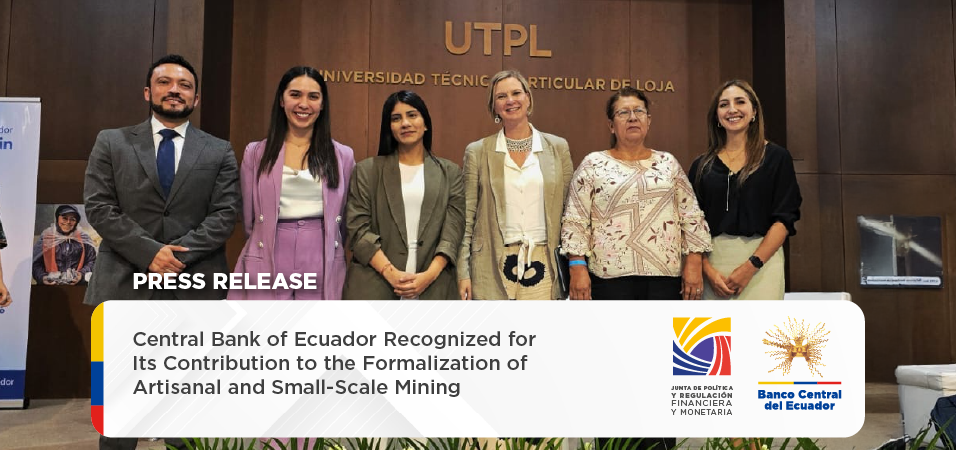
The Financial and Monetary Policy and Regulation Board (JPRFM) and the Central Bank of Ecuador (BCE) took part in the launch of the second edition of the MejORO Training Program, an initiative of the planetGOLD Ecuador project that promotes responsible, sustainable, and mercury-free practices in Artisanal and Small-Scale Mining (ASM). This project is led by the Ministry of Environment and Energy, the United Nations Development Programme (UNDP), and the Global Environment Facility (GEF).
During the event held in Loja, the BCE was recognized for its strategic role and contribution to the formalization, traceability, and strengthening of the sector, through coordinated work with international organizations, public entities, academia, and producer organizations.
In this context, Daniela Moya, a member of the JPRFM, announced that the BCE will take part as a trainer in the 2026 edition of the MejORO Program, contributing technical knowledge and institutional experience toward the consolidation of an increasingly transparent, responsible, and sustainable gold value chain.
“Formalization and traceability are no longer merely regulatory requirements; today they are differentiating factors that build trust, open opportunities, and provide access to increasingly demanding markets,” she said.
In 2025, MejORO trained 130 miners from 20 organizations. For 2026, the training topics have been expanded and five sites have been established in mining districts in the south of the country: Nambija, Chinapintza, Zamora, Macará, and Portovelo. In addition, a childcare space will be available to promote greater participation by women miners, as explained by Erika Bermeo, coordinator of planetGOLD Ecuador.
The event brought together representatives of international organizations, academia, and mining associations, who agreed on the need to consolidate efforts to build a safer, more competitive, and mercury-free mining sector.
The Central Bank of Ecuador (BCE) and the PlanetGOLD initiative maintain a joint agenda to strengthen transparency and responsible gold trading in the country. Work is underway on risk management in the gold supply chain and on reviewing mechanisms to facilitate access to financial products for artisanal and small-scale mining.
Likewise, efforts are being promoted to improve the infrastructure and processes for trading the mineral, and alternatives are being analyzed to incorporate processing plants from Zamora Chinchipe and El Oro into the formal gold trading process with the BCE.


