
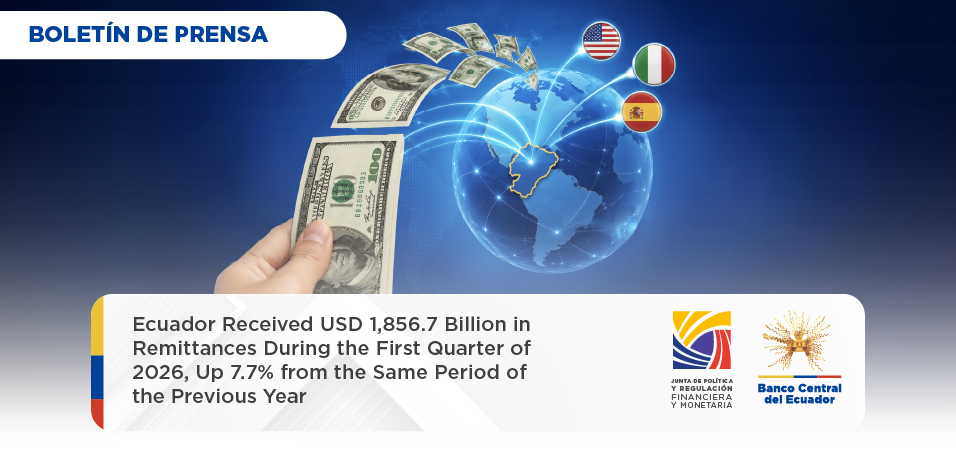
During the first quarter of 2026, Ecuador received USD 1.8567 billion in remittances, representing a 7.7% increase compared with the same period in 2025. These inflows constitute an important source of income for recipient households and contribute to the dynamism of local economies.
The United States remained the leading source country for remittances to Ecuador, accounting for 77.6% of the total amount received between January and March 2026. Together, the United States, Spain, and Italy accounted for 93.7% of total remittance inflows during the period under review.
Remittances from the United States were primarily destined for the provinces of Pichincha, Guayas, Azuay, Cañar, and Chimborazo. In the case of Spain, the second-largest source country, the provinces receiving the highest remittance inflows were Pichincha, Guayas, El Oro, Tungurahua, and Loja. Meanwhile, remittances sent from Italy were mainly directed to Guayas, Pichincha, El Oro, Manabí, and Los Ríos.
Regarding the channels used to receive remittances, 63.1% of total inflows entered the country through private banks. Of these, 77.8% were deposited directly into savings or checking accounts, reflecting greater use of formal financial services for receiving remittances and further progress in financial inclusion.
The performance observed during the first quarter of 2026 confirms the importance of remittances to the Ecuadorian economy, both through their contribution to households’ disposable income and their role in strengthening the financial system and supporting economic activity in the regions that receive these resources.
It is important to note that the Central Bank of Ecuador (BCE) has developed a remittance statistics compilation and processing system based on microdata, supported by standardized validation, data cleansing, and geographic coding processes. This methodology provides more accurate, disaggregated, timely, and reliable monthly information that is consistent with national and international statistical standards. The system records each individual workers’ remittance transaction and includes a comprehensive set of variables identifying the operational and geographic characteristics of every transaction.
Strategic Communications Department
For further information, please visit:
https://contenido.bce.fin.ec/documentos/informacioneconomica/SectorExterno/ix_Remesas.html


