
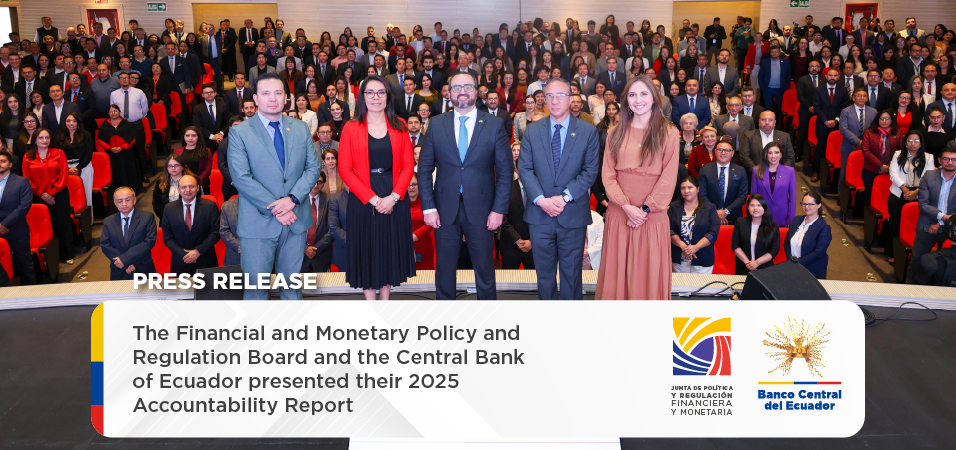
The Financial and Monetary Policy and Regulation Board (JPRFM) and the Central Bank of Ecuador (BCE) held their Accountability event for fiscal year 2025, as part of their commitment to transparency and access to public information.
Gustavo Camacho Dávila, President of the JPRFM, stated that the actions undertaken have been guided by the responsibility to protect stability, strengthen confidence, and lay a firmer foundation for the country’s development, responding both to current challenges and to building a more just future for Ecuadorians. He also emphasized the Board’s commitment to promoting public policies with a territorial focus and addressing the needs of historically excluded groups.
For his part, Jorge Ponce, General Manager of the BCE, highlighted that the achievements reflect the professionalism of the staff, whose work is fundamental to the country. He also noted that these results have allowed the BCE to consolidate its position as a highly prestigious institution and strengthen its institutional standing, geared toward achieving new goals and results.
During the meeting, authorities presented the main milestones achieved throughout the year, framed within a common objective: to strengthen the country’s economic stability and generate confidence among the population. Among the most relevant achievements were decisions aimed at protecting families and boosting the economy, such as the issuance of 21 resolutions, including financial relief measures and the updating of technical instruments that contribute to the soundness of the financial system.
In the macroeconomic sphere, the country reached international reserves of nearly USD 9.8 billion, guaranteeing coverage of the Central Bank’s main balance sheet systems. Liquidity facilities totaling USD 3.34 billion were also consolidated, improving the capacity to respond to adverse scenarios. In addition, institutional equity reached USD 4.3339 billion, and the purchase of gold from small-scale and artisanal miners for more than USD 73.3 million boosted the local economy and the country’s reserves.
In institutional matters, strategic alliances were consolidated with multilateral and academic organizations such as the Inter-American Development Bank, the United Nations Development Programme and Duke University, to strengthen capacities and improve institutional management.
Statistical innovation was also a key focus during 2025, with the dissemination of more than 400 publications, 12 academic studies, and the development of tools such as the macroeconomic environment, the Bioeconomy Satellite Account, and the Monthly Indicator of Economic Activity in Ecuador.
As part of its territorial approach, the Central Bank also strengthened its connection with the public through cultural and educational initiatives. More than 150,000 people visited the Coin Museum, while programs such as the Economic Library and “Central Bank Close to You” expanded their reach nationwide.
The Financial and Monetary Policy and Regulation Board and the Central Bank of Ecuador reiterate their commitment to continue working with technical rigor, transparency, and responsibility to promote financial stability, sustainable economic development, and public confidence.


