
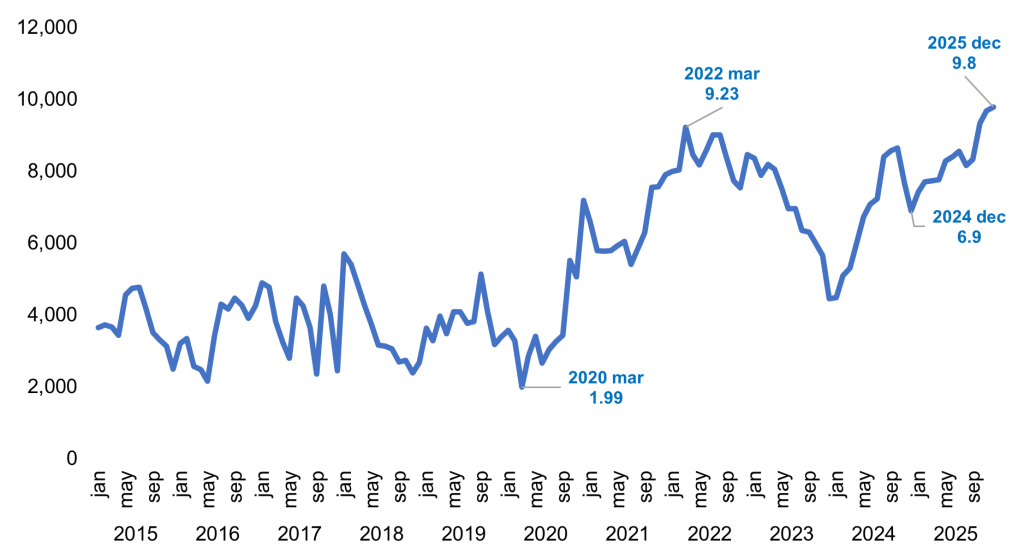
International Reserves (IR) showed a sustained accumulation process throughout 2025, reaching a balance of USD 9.795 billion as of December 31, 2025. This level of IR represented an annual increase of USD 2.895 billion, which allowed for 100% coverage of the liabilities of the first and second balance sheet systems of the Central Bank of Ecuador (BCE).
In this way, the BCE’s responsible and technical management of international reserves allowed it to cover all the resources that public, private, and social and solidarity economy financial institutions hold on deposit with the BCE with liquid assets. Likewise, this adequate level of international reserves allowed it to cover 57% of non-financial public sector entities resources deposited in the BCE, belonging to the third balance sheet system.
Figure 1. International Reserves
(USD billions)
Source: Central Bank of Ecuador
Sectoral evolution of International Reserves
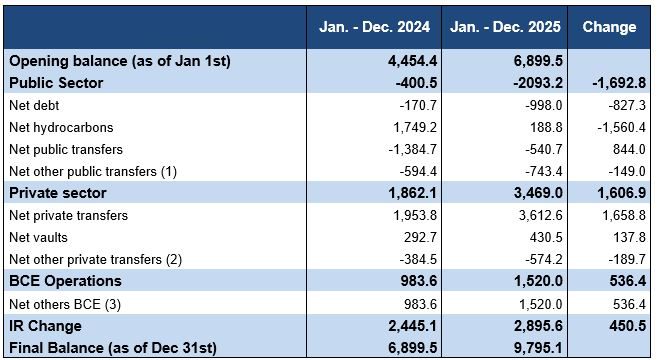
The strengthening of International Reserves between December 2024 and December 2025, increasing from USD 6.9 billion to USD 9.795 billion, was mainly determined by the positive contribution of the private sector and by the operations carried out by the Central Bank of Ecuador (Table 1).
Table1. Cumulative change in international reserves by sector
Source: Central Bank of Ecuador
Notes: (1) Includes primarily cash deposits and withdrawals from BanEcuador, BCE’s vaults and international transfers from the Deposit Insurance Trusts (COSEDE); (2) Includes primarily international transfers from the Liquidity Fund Trusts (COSEDE); (3) Valuation and sale of monetary gold, cash inflows and outflows from operations, and valuation of T-Bills and Fixbis.
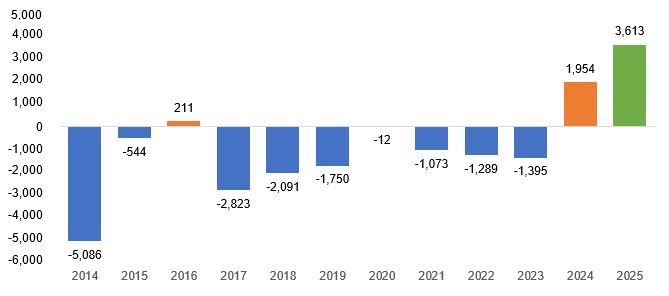
In cumulative terms, the private sector contributed USD 3.469 billion, mainly due to net transfers from abroad, which totaled USD 3.613 billion, the highest value recorded since statistical data for this indicator has been available. This result was in line with the evolution of the non-oil trade balance, which recorded a surplus of USD 3.987 billion between January and October 2025, as well as with the dynamism of remittances received, which registered an accumulated income of USD 5.738 billion between January and September 2025, representing an increase of USD 984 million compared to the same period in 2024.
Figure 2. Net transfers to and from abroad, from the private sector
USD billions
Source: Central Bank of Ecuador
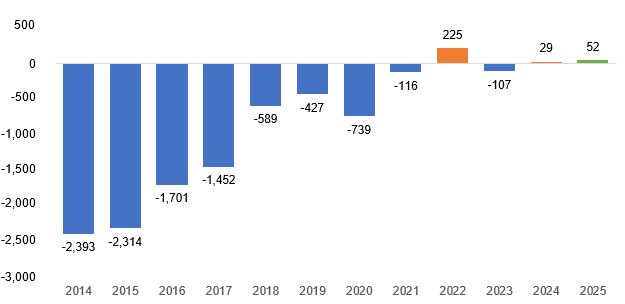
Additionally, in 2025, the difference between cash deposits and withdrawals from the BCE’s vaults by entities within the national financial system showed a positive flow of USD 52 million. From a historical perspective, this behavior demonstrates a lower demand for cash since 2014, which is consistent with the increased use of digital payments by citizens.
Figure 3. Net cash deposits and withdrawals in BCE’s vaults
USD billions
Source: Central Bank of Ecuador
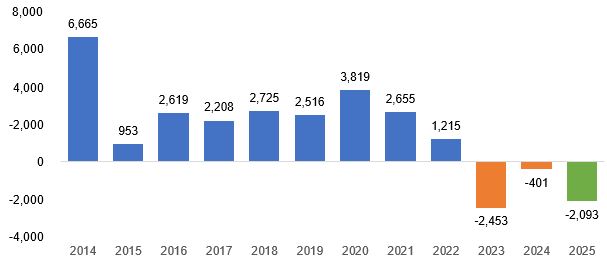
The net value of public sector transfers includes the net values of disbursements and payments for external debt, hydrocarbon imports and exports, and other public sector payments to foreign entities. Public sector transfers resulted in a negative balance of USD 2.093 billion. This decrease is mainly due to the negative net values of public external debt and public transfers to foreign entities, partially offset by the flow of hydrocarbons (Table 1).
Figure 4. Net cumulative transfers from the public sector
USD billions
Source: Central Bank of Ecuador
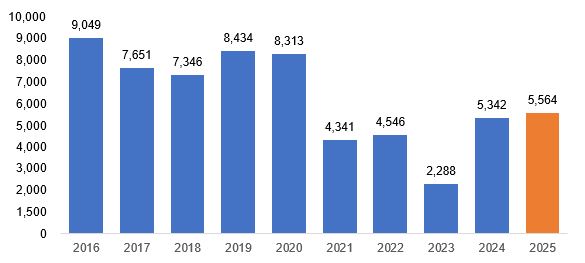
Regarding public external debt flows, and in line with the Extended Fund Facility agreement with the International Monetary Fund, the Ecuadorian State received significantly larger disbursements than those obtained between 2021 and 2023. In particular, the National Government received USD 5.564 billion from multilateral organizations in 2025, representing a 4% increase compared to 2024.
Figure 5. Disbursements for external public debt
USD billions
Source: Central Bank of Ecuador
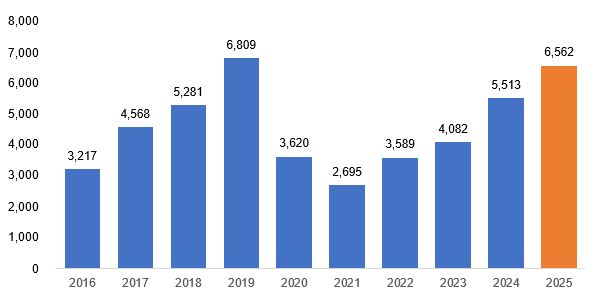
However, the servicing of external debt incurred in previous periods, which includes amortization of principal, interest and commissions, stood at USD 6.562 billion in 2025, an increase of USD 1.050 billion compared to the previous year.
Figure 6. Public external debt service
USD billions
 Source: Central Bank of Ecuador
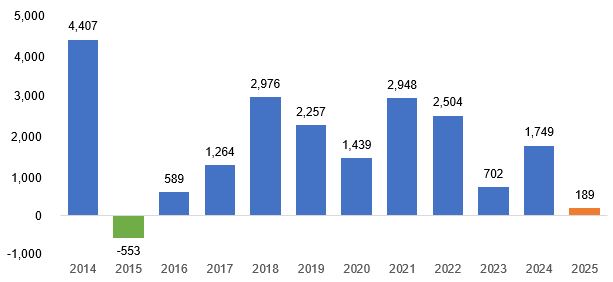
Finally, regarding the oil sector, a net income of USD 189 million was recorded, representing a decrease of USD 1.56 billion compared to 2024. This reduction in net hydrocarbon income is mainly due to the temporary shutdown of crude oil production, which was affected by adverse weather events and operational problems in the Heavy Crude Oil Pipeline (OCP) and the Trans-Ecuadorian Pipeline System (SOTE) in July 2025 [1].
This result is consistent with the lower surplus recorded in the oil trade balance, which stood at USD 1.065 billion between January and October 2025, representing a reduction of USD 1.761 billion compared to the same period in 2024 (USD 2.827 billion) [2].
Figure 7. Net of hydrocarbons
USD billions
Source: Central Bank of Ecuador
The recovery of international reserves throughout 2025 strengthened and enabled the proper functioning of the dollarization system. Furthermore, it guaranteed the supply of currency in circulation nationwide and the payment of funds abroad requested by depositors in the financial system and by public, private, and social and solidarity economy entities.
The Financial and Monetary Policy and Regulation Board and the Central Bank of Ecuador reiterate their commitment to strengthening dollarization and the soundness of the monetary system.
[1] Oil exports were affected by the temporary suspension of pumping on the Trans-Ecuadorian Pipeline System (SOTE) and the Heavy Crude Oil Pipeline (OCP) in July 2025. These interruptions resulted from landslides and regressive erosion processes on the Coca River, associated with extreme weather conditions in the province of Napo.
[2] This 2025 result was driven by a 21% year-on-year contraction in the value of oil exports (USD 1.689 billion) and a 1% year-on-year increase (USD 72 million) in the value of oil imports.


